Geometry from the Start
Geometery from preschool through middle school

When many of us think of our geometry education, we have thoughts of identifying shapes in kindergarten, and then taking a class or two in high school.
The truth is, children are fully capable, and enthusiastically prepared, to learn so much more at a much younger age. While we can’t possibly cover our entire curriculum in one short article, we’ll share some of the highlights. It begins (perhaps unsurprisingly) in our primary classrooms.
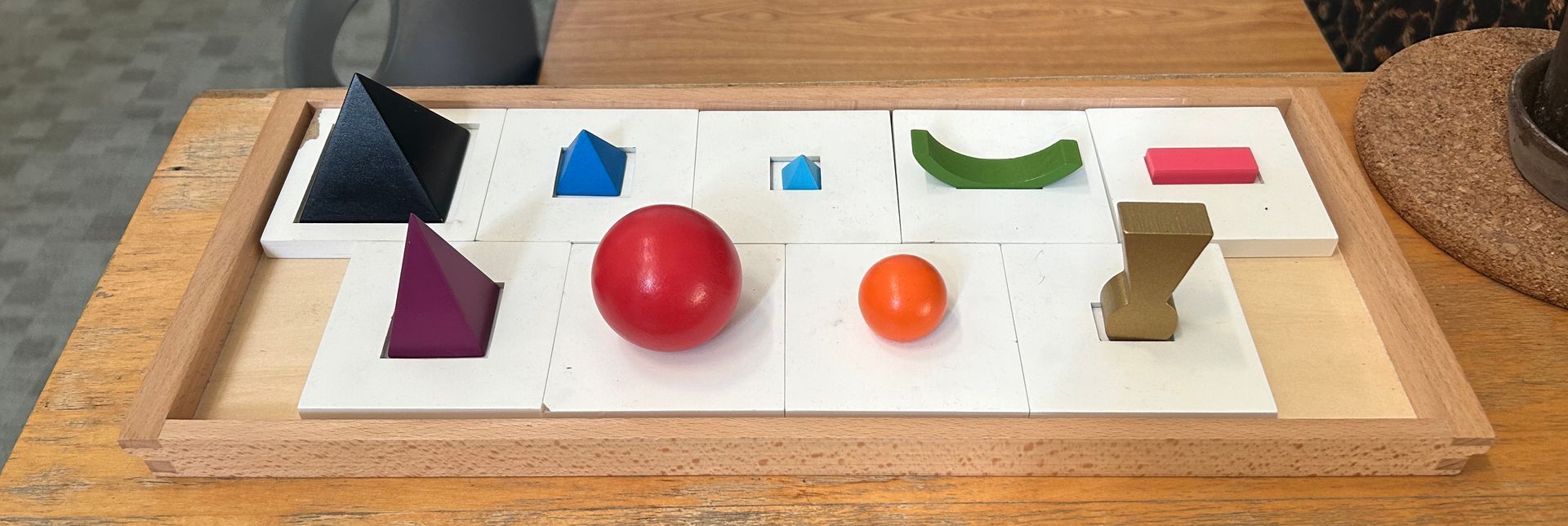
Geometric Solids
Pictured above, the geometric solids are our students’ first direct exposure to geometry. The solids are displayed on a shelf and are contained by a basket or tray. The adult invites the child to a lesson and asks them to retrieve the shapes. They then look at each one. The lesson may go something like this:
1. The guide picks up the cube, feels each side, and hands it to the child. The guide states, “This is a cube.” The cube is placed on the work rug.
2. The process is repeated for each solid in the basket.
3. Depending upon the child’s readiness, they may continue, with the guide asking questions like, “Where is the cylinder?”
4. After the child has had some time to interact with the material independently for a while, the guide will again sit with them and assess their understanding. This is done by holding one sold at a time and asking the child to name it.
There are many fun extensions associated with this material. One favorite includes putting the solids on a mystery bag or using a blindfold so the child has to guess and identify by touch alone.
Geometry Cabinet
The geometry cabinet is used in primary and lower elementary classrooms, although differently in each. What begins as a lesson in identifying basic shapes and discerning between their sizes evolves into complex identification and blending of skills. Some of the skills this material helps us teach our students aged 6-9 include:
· Types of triangles (acute scalene, acute isosceles, right scalene, right isosceles, obtuse scalene, and obtuse isosceles)
· Quadrilaterals (trapezoids, a rhombus, and a parallelogram)
· Regular polygons (pentagon, hexagon, heptagon, octagon, nonagon, and decagon)
· Curved figures (curvilinear triangle, oval, ellipse, quatrefoil)
· Rectangles
· Circles
Constructive Triangles
Beginning during the primary years and continuing through lower elementary, the constructive triangle boxes are another child favorite. A series of boxes teaches a variety of concepts.
1. Triangle box: Used to show how different types of triangles can be combined to make other triangles, also indirectly teaches fractions concepts
2. Large hexagon box: Used to show how triangles can be combined to create other figures, including a hexagon, rhombus, and parallelogram
3. Small hexagon box: A continuation of the same basic concept as the previous box, but this time triangles are used to create rhombi, a trapezoid, and another configuration of a hexagon
4. Rectangle box: Triangles are used to create a square, rectangle, and other quadrilaterals
5. Blue triangles boxes: While the previous boxes utilized different colors for different types of triangles, they are all painted blue here. This is basically an extension of previous work and allows children an opportunity to rely less on previously helpful visual clues. There is also lots of opportunity to use the blue triangles to create more complex geometric figures.
Classified Nomenclature
Once some of the more basic skills have been mastered by the child, sometime during early lower elementary, they move on to engage with the classified nomenclature. As with all other Montessori work, this is a step toward abstraction; they are no longer relying heavily on the wooden materials they can hold and manipulate, rather they are using drawings, booklets, charts, and labels.
This work can become rather in-depth and continues into upper elementary. A very broad overview of skills includes:
· Fundamental concepts (point, line, surface, solid)
· The study of lines
· The study of angles
· Plane figures
· Study of the triangle
· Study of quadrilaterals
· Study of regular polygons
· Study of the circle
These studies are not short lessons like the child has experienced previously. They are multi-layered and can take months to complete. For example, the study of angles may begin during the second year of lower elementary, but continue periodically through the years until the child reaches sixth grade. Concepts include:
· Parts of an angle
· Types of angles
· The measurement of angles
· Constructing angles
· Relationships between two angles
· Two lines and a transversal
· Constructing and copying an angle
· Bisecting an angle
· Operations with angles
Beyond all these amazing materials, it’s important to note that there is a lot of crossover when it comes to Montessori subjects. One perfect example is a favorite grammar work of third graders called the Detective Triangle Game. While its main intention is to practice using correct adjectives, this is done by way of sorting a multitude of triangles, with different colors, types, and angles.
Want to learn more? Please reach out if you have any specific questions and want to have a conversation. As always, we believe the best way to truly understand what goes on in a Montessori classroom is to sit quietly and observe in one. Contact us today to schedule a visit.